Internal communication has never been under more pressure than it is in 2026. Your workforce is hybrid, distributed, or frontline-heavy. Messages compete with packed inboxes, shifting priorities, and nonstop change. The once-loved tactics that worked in an office-first world simply don’t cut it in a digital, hybrid, changing-by-the-day workplace with employees dispersed across time zones, roles, and levels of access to technology. Today, employees expect transparency, context, consistent leadership visibility, and visible follow-through.
The data shows a clear tension. Most organizations have an internal communications strategy in place, and leadership recognizes its importance. Yet execution gaps persist. According to ContactMonkey’s 2026 Global State of Internal Communications Report, 56% of communicators say employees sometimes miss key updates, and 50% estimate employees lose 1-3 hours per week due to unclear communication. It’s no surprise that communication is under strain.
This guide outlines 15 practical, relevant, and timely best practices covering effective internal communications strategy, tailoring communications, non-negotiable data capture, and more. Each best practice includes context, step-by-step implementation instructions, and actionable examples you can adapt immediately to your organization.
Why Internal Communication Must Evolve in 2026
The forces reshaping work and internal communication in 2026 demand a fundamentally different approach to how information flows, leaders build trust, and employees are engaged.
Impact of hybrid and distributed workforces
The shift to hybrid and distributed work has permanently fragmented the shared physical experience that organizations once relied on as an informal communication backbone. IC teams are now responsible for deliberately engineering the connection, context, and culture that used to happen organically. That means reaching employees across different time zones, working patterns, and levels of technology access, while ensuring that no group feels like an afterthought, or worse, isn’t thought about by the organization at all.
Rising employee expectations around transparency and engagement
In the consumer world, buyers have taken a liking to personalized, responsive, honest, and two-way communication experiences. And employees are expecting their organizations to meet a similar standard. Reward Gateway’s Bridging the Communications Gap findings revealed that 80% of employees trust their organization more when communication is transparent. Transparency is critical for trust-building. Additionally, younger generations, notably Gen Zers and millennials, value transparency and authenticity in the workplace and will continue to push for environments that reflect these traits.
The business cost of poor communication
Poor internal communication accumulates quietly, in the form of misaligned teams, duplicated effort, slow decision-making, and employees who disengage long before they hand in their notice. The financial implications are significant: According to Axios, ineffective communication costs companies hundreds of lost working hours and thousands of dollars in lost salaries each year. For example, Axios’ report shows that a single employee earning between $50,000 and $100,000 annually loses 35+ work days per year. On the flip side, Axios suggests that there is a direct correlation between high employee alignment, engagement, and retention, and effective internal communications.
In 2026, the cost of getting it wrong is simply too high to treat IC as an afterthought. The 15 best practices below are grounded in a few core pillars. Here’s a visual overview to help you see the full strategy before we break it down.

Below are 15 best practices for effective internal communication in the modern landscape:
1. Create a Data-Driven Internal Communication Strategy
Data, both quantitative and qualitative, are at the heart of effective, iterative internal communication strategies. Organizations with the most effective IC teams are treating data as critical to their work, not a nice-to-have.
Use analytics to measure open rates, engagement, and feedback
Analytics tools embedded in modern communication platforms, such as ContactMonkey, give IC professionals visibility into when, how, and whether employees receive their messages. Tracking metrics like open rates, scroll depth, click-through rates, and regular pulse survey responses transforms gut-feel decisions into evidence-based ones. It also builds a compelling case for IC’s strategic value within the organization.
Get powerful email analytics and reporting features
Know exactly who is opening and engaging with your employee communications and company newsletters.
Explore analytics & reporting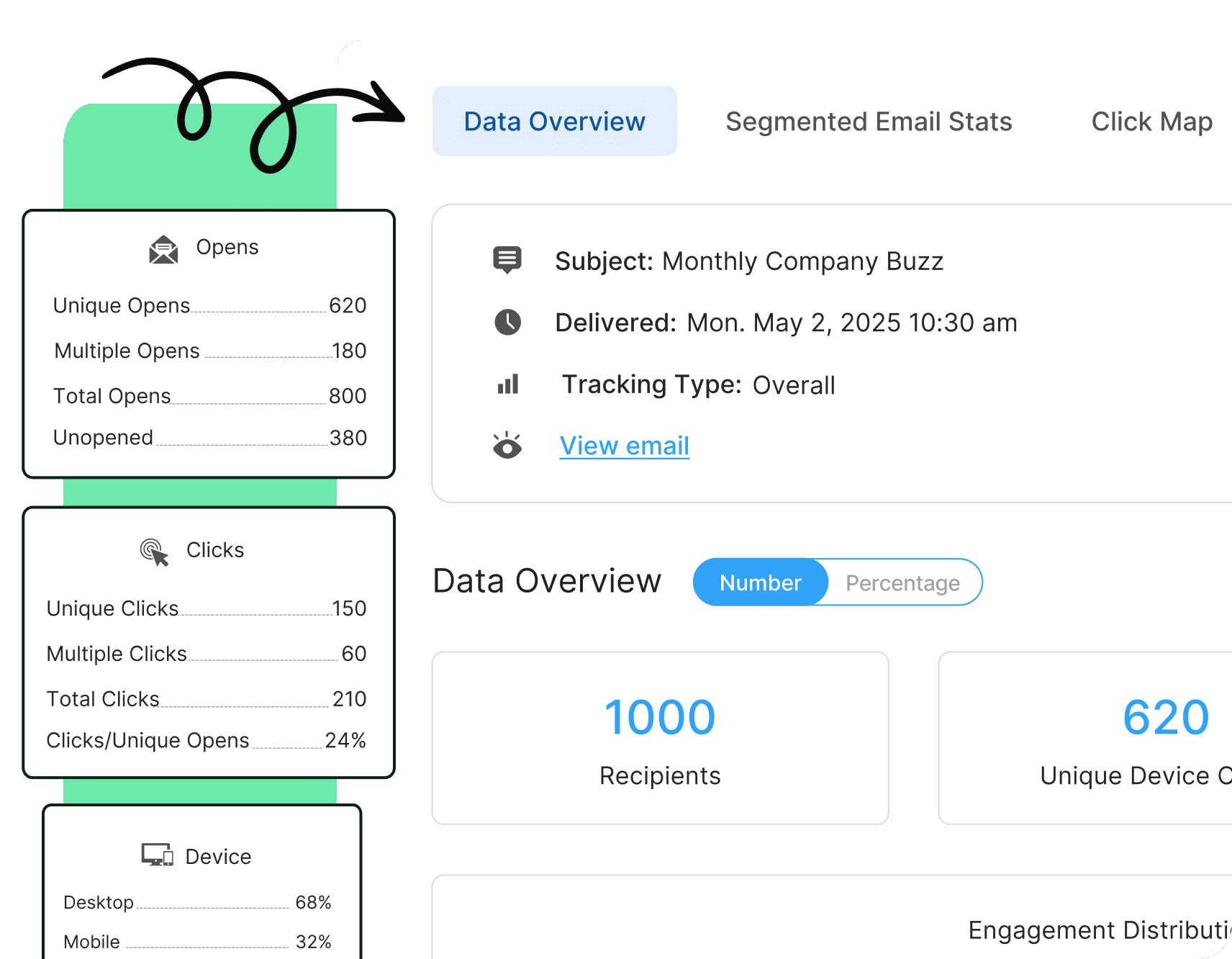

Why this matters: GSIC 2026 reports that nearly 50% of communicators said it is difficult to demonstrate the impact of internal communications. This is rarely because work isn’t happening. It’s because outcomes aren’t clearly defined upfront. Companies historically evaluated internal communications on instinct and assumption. The job was to send the message and cross it off the list. That’s no longer good enough. Organizations that treat IC as a data-driven discipline can identify what resonates, what employees ignore, and where communication gaps create confusion or disengagement. Data transforms IC into a measurable contributor to organizational performance.
How to implement:
1. Audit your current internal communication channels to identify what data is already available to you.
2. Establish a baseline for key metrics (open rates, click-throughs, survey response rates, engagement).
3. Build a simple measurement dashboard (or use ContactMonkey’s customizable dashboards) to review on a regular (monthly, quarterly) cadence.
4. Find opportunities to connect comms data to broader people analytics where possible, such as correlating with retention data or eNPS scores.
Actionable examples:
- After every major all-staff communication, track open and read rates by department to identify which teams are consistently disengaged and follow up with targeted outreach.
- Run a quarterly communication audit comparing channel performance metrics to identify which channels are declining in effectiveness.
- Use pulse survey data alongside communication analytics to test whether a specific messaging campaign improved employee understanding of a strategic initiative.
2. Align Internal Messages with Business Objectives
When employees can draw a straight line between the messages they receive and the direction the organization is heading, communication becomes a strategic asset rather than an administrative function.
Communication priorities = organizational goals
Every communication decision, including what to say, when to say it, and to whom, should be traceable back to at least one organizational priority.
Why this matters: Aligned communication reinforces strategic priorities repeatedly and across multiple channels, which is how understanding and behavioral change actually happen. Building internal email campaigns that support business goals is also how internal communicators position themselves as strategic drivers of positive business impact.
How to implement:
1. At the start of each quarter, map your content calendar against your organization’s top strategic priorities. Learn more about our newest content calendar features.
2. For each major initiative, work with senior leaders to define 3-5 key messages employees need to understand, believe, or act on.
3. Create a consistent message architecture with a hierarchy of organizational, team, and individual-level messages so foundations remain the same as messages cascade.
Actionable examples:
- If the organization’s top priority is customer experience, ensure that internal newsletters, town hall themes, and manager talking points all regularly connect employee behavior back to customers.
- Develop a one-page strategic messaging framework each quarter that IC partners and managers can use to ensure their communications are moving teams in the same direction.
- Before publishing any major piece of internal content, ask: Does this message support at least one of our top organizational priorities?
3. Prioritize Two-Way Communication
Communication that only flows in one direction builds passive audiences, not engaged employees. Today’s working environments call for genuine dialogue and follow-up.
Collect feedback → analyze → follow-up
The feedback loop is only valuable if it’s closed. Collecting employee input through surveys, comment functions, or Q&A sessions, then going silent, is often worse than not asking at all. The most effective two-way internal communication strategies treat follow-up as a non-negotiable, not an optional, step.
Why this matters: IC is evolving into a two-way practice that supports psychological safety. When people feel heard, their trust in leadership increases, their sense of belonging strengthens, and they are more likely to act on the messages they receive.
How to implement:
1. Incorporate a feedback opportunity into every major communication touchpoint (e.g., every internal newsletter includes a reaction option).
2. Develop opportunities for unstructured Q&A sessions where employees can regularly ask questions to leadership.
3. Design a process for closing the loop. Always communicate back to employees and share what, if anything, will change as a result of their feedback.
Actionable examples:
- After each Q&A, publish a brief follow-up summarizing the top questions asked and leadership’s responses, including questions leadership couldn’t answer live.
- Introduce a recurring “You asked, we answered” section in your internal newsletter that responds to employee questions submitted through a dedicated channel.
- After a major change announcement, deploy a short pulse survey within 48 hours to gauge comprehension and surface concerns.
Start two-way conversations and employee feedback loops
Learn how to engage staff with pulse surveys, content ratings and reactions, custom polls, and more. Ready to send modern emails?
See engagement features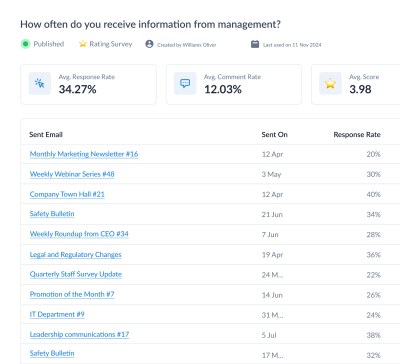

4. Use Personalized Internal Emails at Scale
The world, and our workplaces, are filled with endless noise and notifications. Personalization is about making sure the right content reaches the right people and helps them understand this message is worth pausing for.
Personalization = higher trust and attention
Modern internal communication platforms make audience segmentation and content personalization far more accessible than they were even a few years ago. With dynamic content in ContactMonkey, you can personalize employee emails automatically, so every employee sees what’s most relevant to them, without creating multiple versions of the same message. You can also use merge fields to include names and other relevant personal details.
Why this matters: Personalization signals to the reader that the message was meant for them specifically, capturing their attention. It also reduces the noise caused by over-broadcasting information to audiences who don’t need it.
How to implement:
1. Use an internal communication tool like ContactMonkey for audience segmentation by role, location, tenure, or other groups.
2. Create modular internal email templates with a consistent design but swappable content blocks that allow different audiences to receive tailored, audience-first content.
3. Use dynamic merge fields to include individuals’ names or other relevant information in the email so they know you wrote it just for them.
Actionable examples:
- Send onboarding-specific communication tracks to new hires in their first 30, 60, and 90 days with personalized information.
- When communicating a policy update, lead with the specific implications for each employee group rather than sending a single version. Frontline workers, remote employees, and managers all likely need different details emphasized.
- Take merge fields a step further by including the employee’s name, manager, or team in the message body, not just the greeting.
5. Prioritize Consistency and Clarity Across Channels
When employees aren’t sure where official information lives or receive conflicting messages across platforms, trust erodes quickly, and the IC team’s credibility goes with it.
Reduce noise by creating channel norms
Channel norms give everyone in the organization a shared understanding of each platform’s purpose. Without them, channels multiply, overlap, and compete for attention until employees start tuning everything out. A well-enforced channel framework is one of the most effective noise-reduction tools an IC team can implement.
Why this matters: Channel sprawl is one of the defining internal communication challenges of the current era. When employees receive the same message across five platforms, or when different channels carry contradictory information, confusion and distrust grow. Consistent messaging across channels reinforces key information through repetition, while clear channel norms reduce the cognitive load of figuring out where to look for what.
How to implement:
1. Develop and publish a channel framework that defines the purpose, audience, tone, and expected response time for each channel your organization uses.
2. Establish a single source of truth for key corporate information and build a content archive so employees can access historical communications.
3. Conduct a periodic channel audit to identify overlap, retire ineffective platforms, and enforce the framework with communication owners across the business.
Actionable examples:
- Create a one-page channel guide for employees that answers “Where do I go for what?” and distribute it during onboarding. Update it whenever you introduce a new tool.
- When a major announcement goes out via email, intranet, and digital signage, ensure the core message, tone, and call to action are identical across all three. Only the format should change.
- Introduce a quarterly “channel health check” where the IC team reviews which platforms are growing in engagement and which are declining. Use this information to make consolidation recommendations.
6. Segment and Target Your Internal Audiences
A one-size-fits-all approach to internal communication fits almost no one particularly well. Understanding your audience and what each group actually needs helps drive understanding rather than merely achieve delivery.
Different roles require different messaging
Audience segmentation shows respect and designs with employee uniqueness in mind. Not translating communications into the day-to-day experience of employees, however unintentionally, implies that their context doesn’t matter.
Why this matters: A warehouse operative, a software engineer, a regional sales manager, and a newly promoted people leader each have different information needs, communication preferences, and levels of exposure to organizational messaging. Treating them as a single audience produces communication that feels irrelevant to most of them, and they miss important messages.
How to implement:
1. Conduct an employee stakeholder analysis to determine, define, and understand your organization’s different audiences by function, location, role type, seniority, and communication access.
2. For each segment, document their primary communication needs, preferred channels, and any barriers to receiving or engaging with messages.
3. Use this map to brief content owners and design internal communications campaigns with distinct audience tracks from the get-go.
Actionable examples:
- Develop a frontline worker communication pack separate from your desk-based communications, with relevant formats, channels, and timing. Remember to keep comms equitable but not identical!
- When rolling out a new performance management process, create distinct comms for employees, managers, and HR business partners, each focused on the specific actions and implications relevant to that group.
- Use analytics to identify which employee segments are least engaged with organizational communications, and investigate whether the issue is content, channel, or access-related.

7. Measure Internal Comms Performance and Act on Insights
Don’t measure internal comms performance as a to-do list activity. The real value lies in adjusting, experimenting, and making evidence-based decisions that improve internal communications.
Key metrics: open rates, click-throughs, read time, feedback
These metrics, taken together, tell a much richer story than any single data point in isolation. A high open rate paired with low read time may suggest a misleading subject line or limited time to digest content. Strong click-through rates with low feedback scores could indicate that the content is engaging but not landing in the right tone. Learning how to read and act on the full picture is what separates measurement from understanding.
Why this matters: The value of tracking IC performance lies in what you do with the data. Adjusting send times, retiring ineffective channels, rewriting confusing content, or escalating persistent engagement gaps to leadership with data are strategic decisions. IC teams that build a culture of continuous measurement position themselves to demonstrate their strategic value and to make the case for resources and investment.
How to implement:
1. Define a core set of metrics for each channel and establish internal benchmarks. Use ContactMonkey’s Internal Email Benchmark Report as a guideline.
2. Create a regular assessment and reporting rhythm and review trending data as an IC team or with other relevant stakeholders.
3. Don’t forget to pair quantitative metrics with qualitative signals: What employees say, how they change their behaviors (or don’t), and manager feedback conversations are more revealing than datapoints alone.
Actionable examples:
- After noticing a consistent drop in email open rates on Fridays, test moving your weekly digest to another day and measure the impact over multiple weeks.
- When a major strategy communication receives high open rates but low scores on a follow-up comprehension check, use that data to justify a second-wave explainer campaign rather than moving on to the next campaign.
- Present a quarterly IC scorecard to senior leadership that connects communication performance data to employee engagement indicators, making the business case for IC investment visible and concrete.
8. Design for the Deskless and Distributed Workers
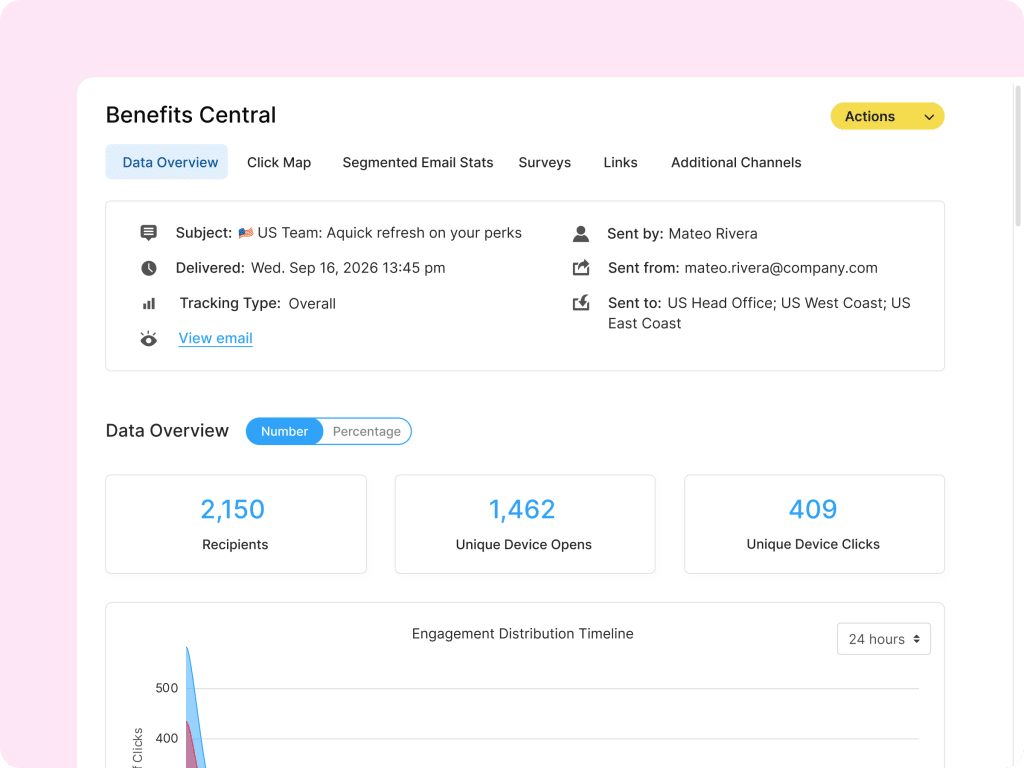
From Benchmark data: 85% of overall email opens occur on desktop. But in industries like healthcare and frontline-heavy environments, mobile usage can exceed 80%. With a plethora of digital channels available to us, it’s not uncommon for internal comms strategies to assume desk-based computer access. But forgetting about your frontline is ineffective and inequitable.
Use mobile-friendly and other frontline-centric formats
Reaching deskless workers requires more than reformatting your messages for mobile accessibility. It involves rethinking the communication experience from their perspective, starting with their environments and how they actually work, and designing accordingly.
Why this matters: In many industries, including manufacturing, retail, and healthcare, the majority of the workforce has no regular access to a company email account or desktop computer during their working day. These employees are among the most undercommunicated groups in any organization, and they are also among the most likely to feel disconnected from organizational culture and strategy. Designing for “average” device usage can quietly leave out the employees who are hardest to reach. When deskless workers are treated as an afterthought, it’s not just a communication gap; it becomes an equity issue and a real business risk.
How to implement:
1. Audit your current communication channels against the working conditions of your deskless population. Do you have enough and the right channels to support these workers?
2. Build a business case for investing in mobile-optimized platforms and dedicated frontline communication apps.
3. With or without a designated frontline tool, prioritize designing content in formats that work for deskless employees around their schedules. That might include short videos, audio updates, and short-form written content.
Actionable examples:
- Replace the weekly written operations update for warehouse staff with a two-minute manager-led video.
- Install digital display screens in break rooms and communal areas to deliver key organizational messages to employees who aren’t regularly checking digital platforms.
- Pilot an SMS or push-notification channel for urgent communications to field-based employees.
9. Leverage Automation and Artificial Intelligence
Organizations routinely ask IC teams to do more with less, and ContactMonkey’s GSIC report supports this. It reveals that almost 1 in 5 IC “teams” consists of a single person, and that nearly 10% of organizations have no dedicated IC teams.
Free up the IC team for strategic planning
Automation and AI tools won’t replace the strategic judgment and human empathy at the heart of great internal communication if you actively choose not to over-rely on them. The goal is augmentation, not replacement.
Why this matters: Internal comms is under-resourced relative to the volume and complexity of communication demands. Automation and AI tools can absorb a significant portion of the production workload, freeing the team to spend more time on strategy, leadership coaching, and the human judgment calls that technology cannot replicate.
How to implement:
1. Audit your current IC workflows to identify high-volume, repetitive, or time-consuming tasks that automation or AI assistance might help with.
2. Choose a tool to experiment with, or explore what’s available inside your internal comms platform, and develop clear guidelines for how to use it and what not to use it for. Avoid introducing too many tools at once.
3. Build in a review layer so that a human always checks AI-generated content before distribution.
Actionable examples:
- Automate the scheduling and distribution of recurring communication series, such as onboarding email tracks or monthly performance updates, so the team is managing the content strategy rather than the logistics.
- Set up automated analytics reports that pull key metrics from your communication platforms weekly, so the team spends less time interpreting data and more time analyzing it.
- Use ContactMonkey’s built-in AI editorial assistant, ConfidenceCheck, to review internal emails and catch issues, like broken links, content lacking context, typos, accessibility issues, and more, before sending.

10. Turn People Managers into Communication Amplifiers
No centralized IC team can match the reach and credibility of a well-prepared people manager speaking directly to their team. Investing in managers as communication partners is a critical part of an effective communications infrastructure.
Equip managers with message templates and talking points
Traditional internal communication approaches emphasized a top-down approach, with limited cascading throughout the hierarchy. The gap between what a manager knows and what they feel confident communicating is often significant, but internal communicators can help bridge this gap.
Why this matters: Managers don’t want to find out information at the same time as the rest of the organization because their direct reports often reach out with questions and concerns. They also offer local context to their team members in a way that company-wide communication can’t. Many managers feel underprepared, underinformed, or unsupported in their communication role. Closing that gap is one of the highest-leverage investments an IC function can make.
How to implement:
1. Build a manager communication toolkit that includes regular briefings ahead of major announcements, ready-to-use talking points and FAQs, and clear expectations around facilitating team conversations and post-announcement follow-ups.
2. Define and create managers-only communication channels that provide managers with a head start on organizational news while allowing them to seek clarification and ask questions as they navigate their own change journey.
3. Work with HR to invest in ongoing communication skills training for people managers as part of their leadership development, or host sessions sponsored by the IC team for people managers to attend.
Actionable examples:
- For every major organizational announcement, send a manager briefing 24-72 hours in advance of the all-staff communication, including suggested talking points, anticipated employee questions, and guidance on how to hold a team conversation.
- Create a regular monthly managers-only communication that provides communication resources, updates on organizational priorities, and reminders of upcoming cascades.
- Run a short quarterly “Communication Clinic” session for people managers to ask questions, share what’s resonating with their teams, and get briefed on what’s coming.
11. Measure Outcomes, Not Outputs
It’s easy to stay busy in internal communications. The harder part is examining whether any of it is actually changing what employees know, believe, or do. Many IC teams already report on open rates, clicks, and attendance. But fewer report on comprehension, behavior change, or decision clarity. So it’s important to understand that outputs show activity, while outcomes show influence.
Consider comprehension, confidence, and cultural change
Outputs tell you what you did. Outcomes tell you whether it worked. A communication that reaches 95% of the workforce but leaves them confused or unconvinced has technically succeeded as an output, but failed to drive outcomes.
Why this matters: IC teams that focus exclusively on outputs can produce large volumes of activity while delivering very little actual change in employee knowledge, behavior, or sentiment. Shifting the measurement frame to outcomes makes the function harder to dismiss and more credibly connected to organizational results.
How to implement:
1. Start every communication initiative by answering: What do we want employees to understand, feel, or do differently as a result of this message?
2. Define and build measurement mechanisms to help your team gauge success, including a pulse survey library, comprehension checks, manager feedback, and behavioral indicators.
3. Report outcomes alongside outputs so that the full picture of IC performance is visible to senior stakeholders.
Actionable examples:
- After a communication campaign, send a short comprehension survey to test whether employees can accurately explain the key points shared.
- Track manager-reported team sentiment after a significant change announcement as a proxy for whether the communication landed effectively across different groups.
- When sharing IC performance data with senior leaders, include an outcomes section near the top of the report and connect outcomes to business objectives.
12. Match Channel to Message and Message to Moment
How you say something matters as much as what you say, and which channel you choose to say it on matters just as much as both.
Build a clear channel framework
A channel framework removes the guesswork from communication planning and ensures that decisions about format and distribution are made deliberately rather than by habit or convenience. It also gives employees a reliable mental model for where to look and what to expect. Over time, this builds the kind of communication confidence that makes people more likely to engage.
Why this matters: Channel mismatch is one of the most common and costly communication errors in organizations. The right channel at the right moment amplifies the message; the wrong one undermines it, regardless of how well-written the content is. Choosing the right channel is even more important when communicating messages around safety and crises.
How to implement:
1. Develop a channel matrix that maps message types (urgent, informational, conversational, celebratory, sensitive, complex) to appropriate channels and formats.
2. Share the channel matrix with all IC partners, communication owners, and senior leaders. Don’t forget to ensure your channel matrix matches any channel definitions provided to employees during onboarding.
3. Build a channel-selection step into your content campaign planning process to make channel decisions deliberately rather than reactively.
Actionable examples:
- Create a simple decision tree for communication owners that asks: Is this urgent? Is it sensitive? Does it require dialogue? Each branch leads to a recommended channel combination.
- When launching a complex organizational initiative, use a sequenced channel approach: a live all-hands to set context, a written summary on the intranet for reference, and a manager cascade for team-level discussion.
- Review your current analytics and metrics and use your data to inform your channel matrix.
13. Lead with Context, Not Just Content
IC teams that invest in context-setting before delivering content produce communications that land with far greater clarity and credibility.
Provide connection points to previous messaging
Every significant communication is part of a larger organizational narrative, whether or not you consciously framed it that way. Employees who can connect a new message to things they’ve already heard are more likely to trust it, understand it, and act on it.
Why this matters: When messages arrive without context, people fill in the gaps themselves, often with incomplete or inaccurate assumptions. Consistently providing the “why” behind communications, and connecting new messages to what employees already know, builds comprehension, reduces anxiety, and positions the IC function as a trusted interpreter of organizational life rather than a message relay service.
How to implement:
1. Add the following questions to every content planning brief or template you use: What do employees already know about this topic? What do we need them to understand now, and why? How does this connect to messages they’ve already received?
2. Update or create templates to include an introductory section that grounds readers in the historical context before sharing new information.
3. Coach leaders on effective context-setting strategies to incorporate into their communications and keynotes, especially during periods of significant change.
Actionable examples:
- Open major announcements with a brief “Where we’ve been” paragraph that connects the new information to previous communications or organizational milestones employees will recognize.
- Incorporate visual timelines in your communications to display the full campaign messaging and key dates.
- When briefing a leader ahead of an all-hands, include a “context map” that summarizes the key messages employees have already received for each agenda topic. Encourage them to build on the context continuously and to reiterate key points before introducing new ones.
14. Build an Effective Change Communication Cadence
Change is constant in most organizations, but the communication that surrounds it is often murky and inconsistent.
Communicate change before, during, and long after it happens
The announcement is only the beginning of the communication challenge. Change can induce fear and uncertainty, and internal communication plays a critical role in supporting employees as they navigate it.
Why this matters: Most organizations invest heavily in announcing change and almost nothing in sustaining communication throughout the implementation period and beyond. Yet the messy middle (during the change) is when employees need clear, honest, and regular communication. A well-designed change communication cadence builds the psychological safety employees need to navigate uncertainty and stay engaged through disruption.
How to implement:
1. For change-focused internal communications, build a phased plan that covers the pre-announcement period (building and crafting communications and preparing managers), the day of announcement (context, rationale, delivery plan, and channels), the implementation period (regular progress updates, honest challenges, and two-way feedback), and the post-implemetation period (celebrating milestones and connecting back to business objectives).
2. Work with stakeholders to build out each phase and the supporting communications needed.
3. Develop a process that works for your team and formalize it so change communications are repeatable and consistent.
Actionable examples:
- Map a change communication timeline onto a visual calendar, with specific communication touchpoints for each phase.
- Introduce a “change pulse” survey to surface emerging employee concerns during change before they escalate. Feed insights back into the communication plan.
- After a major change, share reflections on what went well, what was harder than expected, and what the organization learned.
15. Continuously Test, Improve, and Adapt
There’s never a “perfect” endpoint to reach in internal communication. Things are always changing, and comms strategies need to change accordingly.
Iterate on your comms strategy, don’t set it and forget it
Iteration doesn’t require significant resources or dramatic overhauls. Some of the most valuable improvements come from small, disciplined experiments. The discipline is in building testing habits into regular practice rather than waiting for a formal review cycle to surface what isn’t working.
Why this matters: The organizations, workforces, and communication landscapes of 2026 are not static. Employee expectations are shifting, new tools are emerging, business priorities are evolving, and the competitive pressure on attention is intensifying. IC teams that build iteration into their operations will outperform those that treat strategy as a one-time exercise.
How to implement:
1. Establish a regular review cadence for tactical adjustments and strategic realignments. Assess what’s working, what isn’t, and what has changed in the organizational or external environment that requires a response.
2. Build a culture of low-stakes experimentation within the team: format tests, timing changes, or different content approaches can generate learning without large resource commitments.
3. Create an experimentation repository to document what you learn and build it into your standard practices so institutional knowledge compounds.
Actionable examples:
- Run a structured A/B test on your most important recurring communication, such as your weekly emails. Test subject lines, send times, content order, or format (just not all of these at once), and measure the impact on open and clickthrough rates using a tool like ContactMonkey.
- Hold a retrospective with the IC team and a sample of managers and employees, to ask: What’s working well, what’s getting in the way, and what do you wish we’d do differently?
- Maintain a living “lessons learned” document, and make reviewing it a standard step in the planning process for anything new.
Final Thoughts: What Makes Internal Communication Truly Effective Today?
Effective internal communication in 2026 is about clarity, alignment, and measurable follow-through. Simply put, it’s about sending the right messages to the right people through the right channels at the right time.
Summary of key best practices
Across all 15 best practices, these are the core key themes to remember:
- Strategy before execution: Align internal communication priorities to organizational goals, equipping leaders and managers, and making deliberate decisions rather than reactive ones.
- Data and measurement are non-negotiable: A culture of continuous measurement is what separates IC teams that improve from those that simply repeat.
- Prioritize two-way dialogue: Listening, closing the feedback loop, and being honest about uncertainty are as important as any message an organization puts out.
- Great internal communication strategies never reach a final destination: The organizations that will lead on IC in the years ahead are those that treat their strategies as living and breathing.
Most organizations already have channels, surveys, and leadership recognition of IC’s importance. What differentiates high-performing teams is not more activity, but stronger infrastructure:
- Clear measurement frameworks
- Segmentation discipline
- Closed feedback loops
- Manager enablement
- Strategic alignment to business goals
Internal communication fails when execution is stretched across too few people, too many channels, and unclear success metrics. That’s where modern IC teams can win.
Encourage continuous innovation and listening
Continuous innovation in IC requires building a culture of curiosity within your team, where listening to employees is treated as an ongoing exercise with endless benefits. That means creating regular feedback loops and staying close to your workforce’s evolving needs through internal communication metrics and data.
ContactMonkey helps internal communicators design better emails, track real employee engagement, and prove the value of their work with real-time analytics, all from directly within Outlook or Gmail.
See how ContactMonkey can help you simplify internal communications and drive measurable engagement. Book a demo today to learn more!